

A rigid box production line is a sequence of five to seven stations, and the box changes hands at every one of them. What the line produces is set by the slowest station and by how much work waits between stations, not by the fastest machine on the floor.
Most line problems we are asked about are described as machine faults and turn out to be flow problems: a forming station waiting for wrap, a grooving station producing faster than the next station can take, or a packing bench that becomes the queue at the end of the shift. This article follows a single box from board to finished shell, describes what each station does to it, and shows where the line usually slows down and how to measure it without buying software.
Follow One Box Through a Rigid Box Production Line
Start with a sheet of greyboard and a roll of printed wrap. The board is grooved so it can fold, taped at the corners so the shell holds its shape, and paired with wrap paper that has been glued on one side. The two meet at the box making station, where the board is positioned on the wrap, the edges are turned in and the corners folded, and the flat assembly is pressed into a three-dimensional shell at the forming station. Inspection and packing follow, and if the box has a lid and a base, an assembly step sits between forming and packing.
Read that sequence again and notice how many times the box is picked up. Every transfer is a chance to lose register, mark a printed surface or build a queue. An automatic line reduces those transfers; it does not remove them, and the places where transfers remain are where the losses concentrate.
Station by Station
Each station changes what the next one can accept, so the sequence matters as much as the machine list. These are the stations we configure most often, and what each one decides for the rest of the line.
1. Grooving
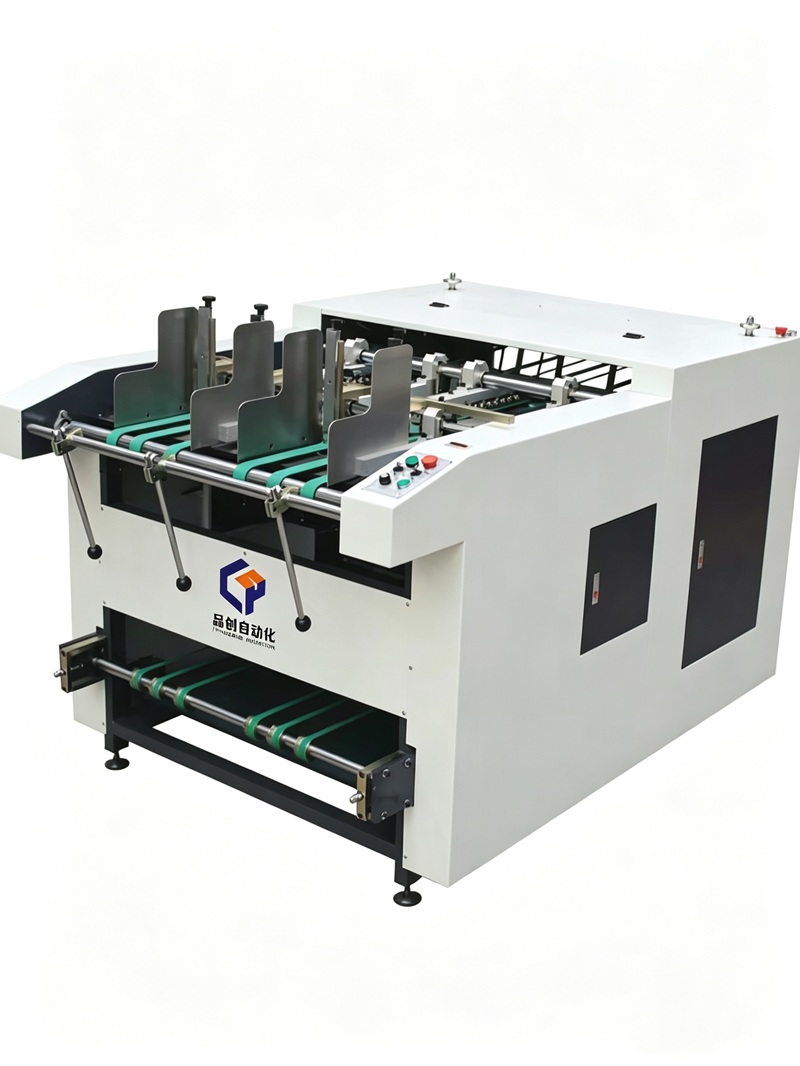
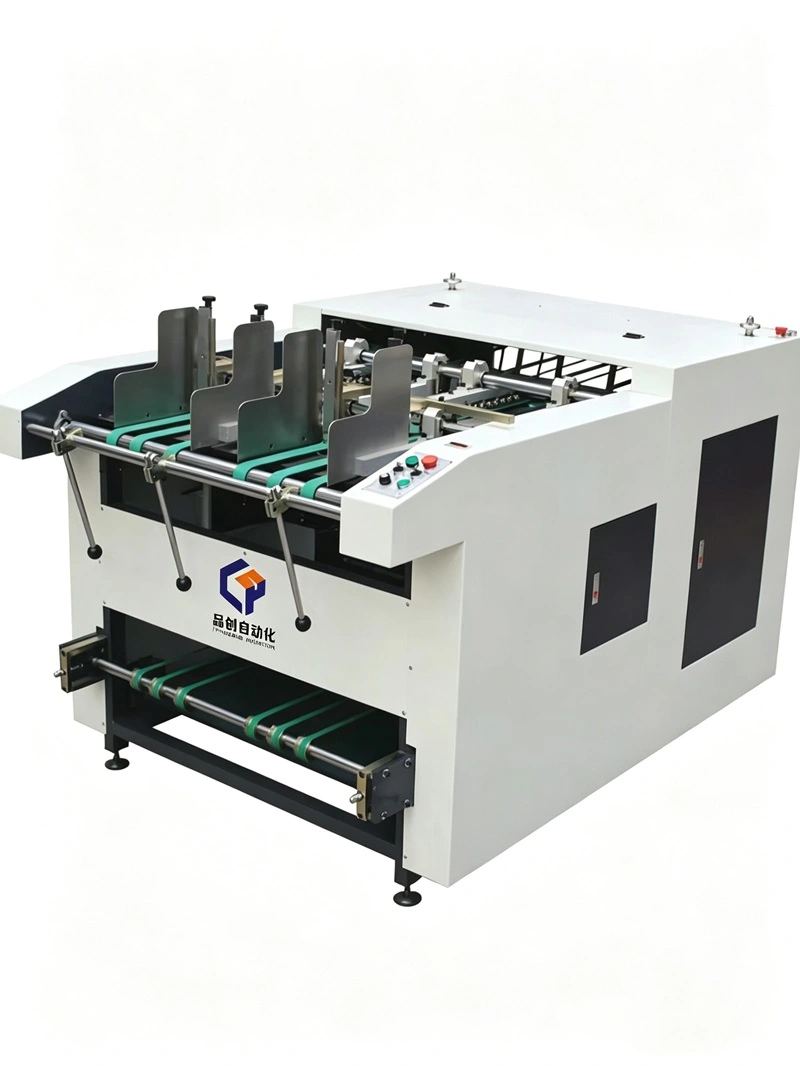
A V grooving machine cuts the channels that let a board fold without cracking the liner. Groove depth and position decide whether the corner comes out sharp or rounded, and they are set before wrapping rather than corrected afterwards. Grooving is also the station most sensitive to board quality: board that varies in thickness produces grooves that vary in depth, and the difference appears two stations later as an uneven lid.
2. Corner pasting
The corner pasting machine applies tape across the corners of the flat board shell. It looks like a minor step, and in many plants it is still done by hand at a bench beside the line. A corner taped off centre pulls the shell out of square, and no forming station can put it back. This is the most common cause of a box that fits its lid on one side and gaps on the other.
3. Gluing
The paper gluing machine lays an even adhesive film on the wrap. Too little and the wrap lifts at the rim after a few days in a warehouse; too much and the paper cockles before it reaches forming. On light decorative papers the difference between a good and a bad film is a small adjustment that has to hold for the entire run, which is why an even roller matters more than a fast one.
4. Box making and positioning
The board is placed on the glued wrap and located before the edges are turned in. Mechanical referencing is fast and repeatable on unprinted work; printed wraps with a border need the position of the print to decide the position of the board, and that is the job of visual positioning. This is the station where a printed design either lines up with the box or does not.
5. Forming
The wrapped flat is pressed into a shell with walls. A rigid box forming machine sets wall height, corner definition and how square the base sits. Its cycle time usually becomes the pace of the line, because forming is the step where every earlier decision either works or fails. On a single-station platform, a mould change here also stops everything upstream.
6. Assembly and inspection
Lids meet bases, inserts go in, and the box is checked against the specification. Where this is manual, it becomes the hidden constraint: it never appears in a capacity calculation, but it is the reason the last hour of the shift produces less than the first. Inspection belongs here as a defined step with a defined sample and a written standard, not as something an operator does while watching the machine.


The Three Usual Bottlenecks and How to Find Yours
Across the lines we commission, three constraints account for most of the loss, and only one of them is a machine.
The first is forming. It carries the longest cycle on the line, it changes moulds most often, and on a single-station platform a change stops everything upstream. The symptom is work in progress piling up in front of it while the stations behind it sit waiting.
The second is the hand operation nobody counted: taping corners, inserting, closing lids, packing. These steps rarely appear in a machine quotation, so they are rarely planned for, and they surface as an unexplained gap between rated and actual output. The symptom is idle machines at the end of the month while the benches are overloaded.
The third is material supply. Wrap and board arrive in batches, and a line running several sizes a day needs the right stack at the right station at the right time. If the line stops for material more than for machine faults, the constraint is upstream of the equipment, in how material is staged.
Finding your own bottleneck is simpler than it sounds: walk the line and look for where the piles are. Work in progress accumulates immediately before the constraint, never after it. If there is no pile anywhere, the constraint is probably labour or material handling rather than a machine.
Measuring Line Performance Without Extra Software
A clipboard and a shift sheet will tell you more than a dashboard built on estimated cycle times. Record four things for one week on your normal mix: boxes out per hour, every stop longer than two minutes with its reason, the number of size changes, and the number of rejects by cause.
| What you record | What it tells you |
|---|---|
| Boxes out per hour | The real rate on your mix, which is usually well below the rated figure and is the only number worth planning with |
| Stop reasons over two minutes | The station with the longest total stopped time is the constraint, and it is often not the slowest machine on paper |
| Size changes per day | How much of the loss is changeover rather than running, which decides whether a faster machine would help at all |
| Rejects by cause | Whether the loss is upstream of forming, which is where corner and groove defects originate |
One week of honest recording usually changes the purchase conversation. Plants that were about to buy a faster forming station often find that changeover or corner taping is the real constraint, and that a rigid box making machine with a different station arrangement solves it without adding output they cannot feed.
Pinchuang has built rigid box and case making equipment in Dongguan since 2008, in a facility of around 10,000 m² with more than 100 employees, and supplies machines to over 30 countries. We exhibit at All in Print China, Printing South China, China Print, Drupa, SINO FOLDING CARTON and WEPACK. The configurations behind these lines are listed on our machine range page, and the box types they are used for on the applications page.
Common Questions About Line Flow
How many stations should a rigid box production line have?
Grooving, corner pasting, gluing, box making and forming are the core five. Assembly and inspection follow where the box has a lid and a base or where the customer requires a documented check. A line with fewer stations is not necessarily cheaper to run: it moves labour to a bench instead of removing it.
Can the stations run at different speeds?
They do, whether or not you plan for it. Rated rates differ between stations, and the effective rate depends on box size and material. A line is balanced when the slowest station runs at the rate you need, and a small buffer in front of it absorbs the short stops of the rest.
Where do most defects actually come from?
From the stations before forming, not from forming itself. A box that will not sit flat usually traces back to groove depth, wrap tension or board moisture; a lid that gaps on one side traces back to a corner taped out of square. Rejects recorded by cause rather than by count make this visible within a week.
Is a second forming station always the answer?
Only when forming is genuinely the constraint and the box range fits the platform's working limits. If the recorded stops sit at corner taping, packing or material supply, a second forming station adds capacity you cannot feed and hides the real problem for another year.
If your rigid box production line is producing less than the rated figures suggest, send Pinchuang a week of output and stop records. We will tell you which station is setting your pace and what to change before any machine is ordered.
Send a week of line data Match stations to your paceRigid box production line planning · Pinchuang, Dongguan, China