

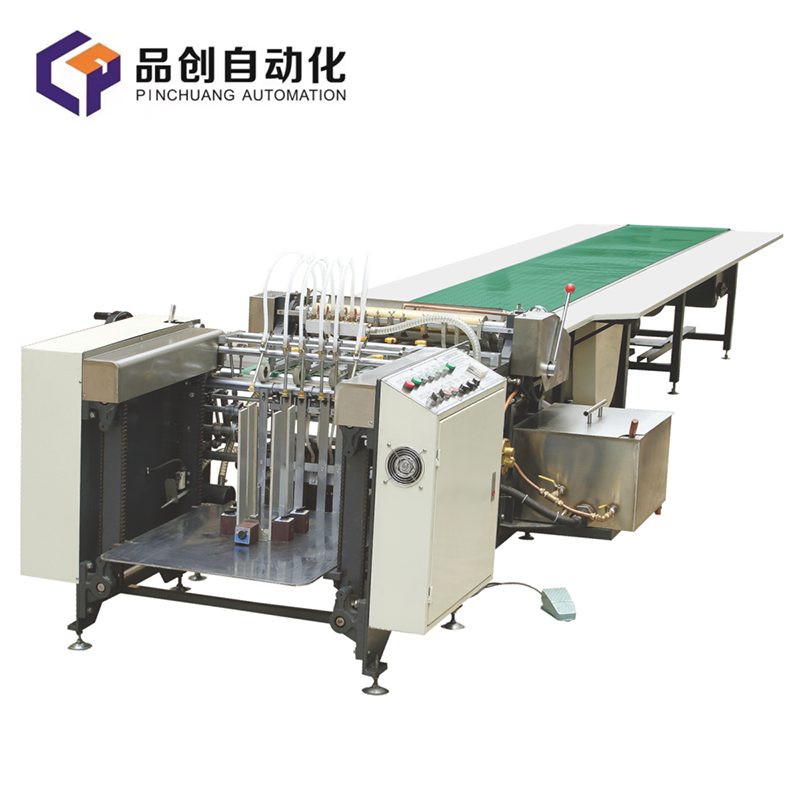
A fully automatic box making line takes flat greyboard and printed wrap at one end and delivers wrapped, formed rigid boxes at the other, with no manual handling between stations. Automation covers grooving, gluing, positioning, forming and transfer; it does not cover loading, inspection, tooling change or packing.
That last sentence is where most purchase decisions go wrong. "Fully automatic" describes the material flow, not the labour count, and a plant that expects zero operators at the end of the line usually ends up with three people standing at the exit instead of one. This article sets out what a fully automatic box making line actually does end to end, what has to be fed into it, how the transfers work, and where people are still required.
What Fully Automatic Means End to End
In practice, a fully automatic box making line links four processes that used to be separate benches: grooving, corner taping, wrap gluing and box forming, with box making and positioning sitting between gluing and forming. Material moves by conveyor or transfer unit, and the operator's job shifts from handling boxes to watching settings and responding to stops.
The difference between a semi-automatic arrangement and a fully automatic line is not a single machine. It is whether the handover points are automated. Each handover removed takes a person, a queue and a source of misalignment out of the process, and each one is also a place where a fault now travels further before anyone notices it.
This is why the first question in any line project should be about the box, not the machine. Box size range, board thickness, wrap weight and the presence of print on the wrap decide which stations can be linked and which have to stay separate.
What Goes In: Board, Wrap, Glue and Tape
A line is only as stable as its inputs. Four materials decide whether it runs for a shift without adjustment, and all four are easier to control at goods-in than at the machine.
Board is the first. Greyboard for rigid boxes typically runs 1–3 mm, and thickness variation within a pallet changes groove depth and forming pressure. Board that has absorbed moisture from a cold container will move after grooving, which is why plants in humid climates let deliveries stand before running them. The same board that behaves perfectly in a dry month can produce warped lids in a wet one.
Wrap paper is the second, usually 80–200 g/m² for rigid box work. Light decorative papers are less forgiving of glue weight than coated stock, and heavily textured papers hide bubbles on the face while allowing the turn-in to lift later. Printing adds a third variable: a wrap printed with a border needs the board located against the print, which is where visual positioning enters the specification.
Glue and tape are the two consumables most often left to purchasing rather than production. Adhesive that changes viscosity between batches changes the film on the wrap, and a tape that is 10 mm narrower than specified changes corner strength. Both are cheap to control and expensive to discover at the end of a run.
Automatic Transfer Between Stations
Transfer is the part of a line that buyers examine least and operators complain about most. A transfer that works at 20 pcs/min but not at 35 becomes the reason a machine never reaches its rated speed, and the symptom looks like a machine fault rather than a transfer problem.
Three things make transfers reliable. The first is a consistent reference: every station should locate the board the same way, so a piece that leaves grooving square arrives at forming square. The second is a small buffer between stations, enough to cover a two-minute intervention; not more, because a large buffer hides the constraint rather than absorbing it. The third is access: a transfer unit that cannot be reached from two sides turns a five-minute jam into a twenty-minute stop.
In a layout plan, draw the transfer paths at true scale including the space needed to clear a jam. Machine footprints are quoted; access is not, and access is what the shift actually lives with.


Where a Human Is Still Needed
A fully automatic box making line still needs people at four points, and planning those points properly is what separates a line that runs from a line that is constantly attended.
Quality control
Inspection stays with people, and it works best as a defined job rather than an extra task. One inspector, a written standard, and a sample of a fixed number of boxes per shift will catch more than continuous casual checking. The standard should describe what a good corner, a good turn-in and a good wrap edge look like, because "looks right" is not a specification.
Loading board and wrap
Feeding the line is manual on almost every installation. Stacks have to be loaded at the grooving station and wrap at the gluing station, and each size change means new stacks and a different pile height. The workload is not heavy, but it is constant, and it is the reason a line running three sizes a day cannot be left alone for long.
Tooling change
Mould changes need trained hands. Two people who change every mould in the same order, using a recorded sheet of settings, will consistently beat a larger team improvising. This is a planning decision rather than a machine option, and it usually has more effect on weekly output than any speed rating.
Packing at the exit
Rigid boxes are bulky and mark easily, so most plants pack by hand. Put the packing bench at the exit with room for cartons and a pallet position; a line that discharges into a walkway loses in packing what it gained in forming.
Pinchuang has manufactured rigid box and case making equipment in Dongguan since 2008, in a facility of around 10,000 m² with more than 100 employees, and supplies machines to over 30 countries. We exhibit at All in Print China, Printing South China, China Print, Drupa, SINO FOLDING CARTON and WEPACK. The stations that make up these lines are listed on our machine range page, and the box types they run on the applications page.
Common Questions About Fully Automatic Lines
Does a fully automatic box making line need operators?
Yes. Automation removes handling between stations, not the people around them. Expect to staff loading, inspection, tooling change and packing, which on a typical installation means a small team per shift rather than one person per machine.
What box range can such a line handle?
On the platforms we build, boxes from 65 × 65 × 15 mm up to 500 × 400 × 120 mm, using 1–3 mm board and 80–200 g/m² wrap. Below or above that envelope the station arrangement changes, so it is worth checking your smallest and largest box before comparing models.
Can the line run printed wrap with a border?
It can, but the wrap has to be positioned against the print rather than against the board edge. That is what visual positioning does, and it is the option to specify at the start: retrofitting it later is a different project, while choosing it up front is a line item.
How long does a size change take?
It depends on how many moulds and settings are involved and, more than anything, on whether the change is done by trained people following a recorded sequence. Time an existing change on your own equipment, including the trial boxes and the first-hour rejects, and treat that figure as the baseline any new line has to beat.
Tell Pinchuang what goes into your boxes and what has to come out at the other end. We will map a fully automatic box making line around your board, wrap and box range, and mark the four points where people are still needed.
Map the line around my box See the forming stations