

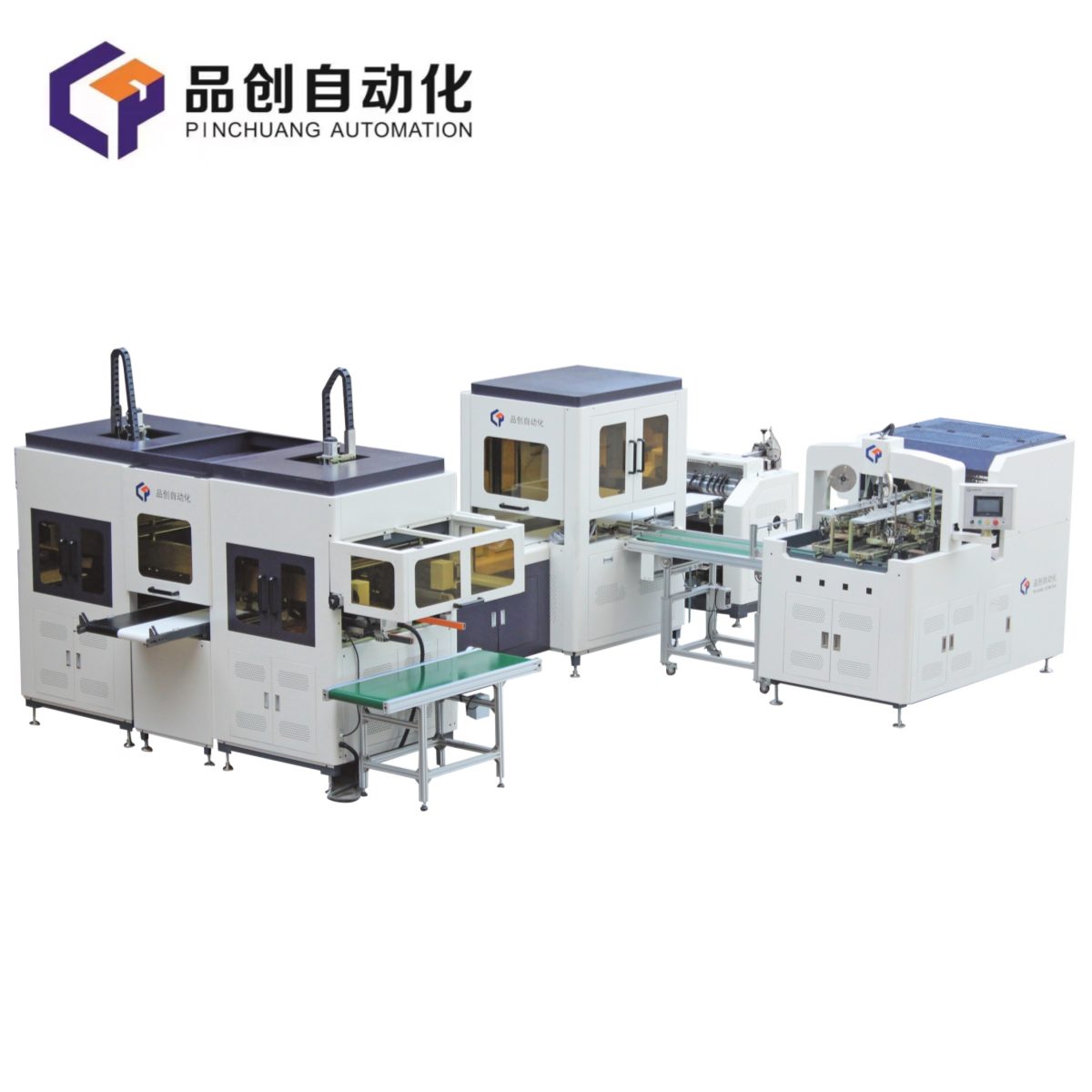
Choosing an automatic box making machine starts with your box, not the brochure: the size range you must cover, the board and wrap you actually buy, and the number of size changes per week. Speed and price come after those three, because a machine that cannot run your smallest box is not cheap at any speed.
Most buying mistakes we see are specification mismatches rather than bad machines. A model is selected on its rated output, arrives, and then spends its first month running at half rate because the box range sits at the edge of its working envelope or the wrap is lighter than the gluing station was set for. This guide sets out the sequence we use when a plant asks us to help specify an automatic box making machine, and the numbers worth writing down before any comparison.
Start from the Box, Not the Brochure
Take three boxes from your current production: the smallest, the largest, and the one that gives you the most trouble. Measure all three, including wall height, and write down the board thickness and wrap weight for each. That sheet is the only specification that matters in the first conversation, and it takes an hour to produce.
Wall height is the figure most often left out and the one that changes cycle time most. A 25 mm lid and a 110 mm gift base can share a footprint and share nothing else at the forming station: the taller box needs more wrap travel, holds corners differently, and runs slower even on a machine rated for the size.
Then decide what you will not run. Every machine has an envelope, and the useful question is not whether a model can technically accept a size but whether it will run that size repeatedly at a rate that pays for the tooling. Plants that buy for the extreme size and run the middle of the range most of the time usually overpay for capability they rarely use.
Map Your Range: Size, Board, Wrap, Tolerance
Four attributes decide which machine family fits, and each one narrows the list in a different way.
Size sets the working envelope. As a reference, the PC-5040A and PC-5040B cover 65 × 65 × 15 mm up to 500 × 400 × 120 mm, while the compact PC-350B covers 45 × 45 × 15 mm up to L 300 × W 260 × H 100 mm. If your work is jewellery and cosmetics formats, the compact envelope is not a limitation; if you run large gift bases, it disqualifies the model immediately.
Board thickness sets the grooving and forming requirement, and 1–3 mm is the working range on these platforms. Board at the top of that range needs more forming pressure and a different mould, and board that varies within a pallet produces boxes that vary with it.
Wrap weight and surface set the gluing requirement. Light decorative paper at 80–200 g/m² is less forgiving than coated stock: it cockles with too much adhesive and lifts at the rim with too little. If your wrap changes between seasons, say so at the specification stage rather than discovering it during a Christmas run.
Tolerance sets the positioning method. Printed wraps with a border need the board located against the print, which is what visual positioning does; unprinted or all-over patterns can usually run on mechanical referencing. Specifying the wrong one shows up as a border that drifts by a millimetre across a shift.
Required Output vs Realistic Capacity
Rated output is measured under conditions your plant will not reproduce all day. The realistic figure is the rated rate discounted for changeover, stops and inspection, and it is the number to compare against your order book.
A simple way to get there: take your rated rate, multiply by the share of the shift the machine actually runs, then subtract the boxes lost at the start of each run while settings settle. On mixed work, that second figure is often larger than buyers expect. A machine rated at 40 pcs/min on a single size does not deliver 40 pcs/min on a day with four size changes.
The consequence for selection is straightforward. If your volume comes from long runs, a higher rated model pays for itself. If it comes from many short runs, a machine that changes over quickly and repeats its settings will beat a faster one that takes an hour to set.

Tooling and Changeover
Moulds are the part of the purchase that keeps costing after delivery, and the part most often estimated from a single figure. Ask what a mould set costs for your most common box, how many sets a typical plant keeps, and how the mould is located and locked. A tooling system that locates without adjustment is worth more than a faster cycle on mixed work.
Changeover practice decides how much of that tooling investment you recover. Moulds stored at the line, labelled by size; a settings sheet per box kept with the mould; and the same two people doing every change. None of these are machine features, and together they usually halve changeover time compared with plants that improvise.
For a compact second line, the same logic applies in reverse. A small machine that shares mould thinking with the main line saves training and spares, even if its rated speed is lower than a large platform running one box size all year.
Ask also how the machine holds its settings between runs. A forming station that returns to the same stop position after every change is the difference between a repeatable box and one that needs a fresh adjustment each morning. Where a builder can show the locating method rather than describe it, the answer is usually reliable; where the question is answered with a cycle rate, it is worth asking again.
Finally, check the service path. Wear parts, mould lead times and how quickly a technician can reach you decide the cost of a bad week far more than the purchase figure does. A machine that is easy to maintain locally is usually the better investment for a plant running two shifts.

Selection Table by Box Type
This table is the shortcut version of the reasoning above. It is not a substitute for measuring your own boxes, but it shows which attribute usually decides the choice.
| Box type | What decides the machine |
|---|---|
| Jewellery and watch boxes | The small end of the range and the tightest corner definition, so the minimum box size decides first |
| Cosmetic and perfume boxes | Printed wrap with tight register, which puts visual positioning into the specification early |
| Gift and electronics boxes | Larger footprints and seasonal peaks, so the maximum size and the peak rate decide together |
| Tea and spirits boxes | Taller walls and heavier board, which lengthen the forming cycle more than the rated speed suggests |
| Multi-part presentation sets | How many components meet at assembly, which decides whether a combined platform or a line is the better fit |
Pinchuang has built rigid box making machines and case making equipment in Dongguan since 2008, in a facility of around 10,000 m² with more than 100 employees, and supplies machines to over 30 countries. We exhibit at All in Print China, Printing South China, China Print, Drupa, SINO FOLDING CARTON and WEPACK. The full model list is on our machine range page, and the box types behind them on the applications page.
Common Questions About Machine Selection
Is a faster automatic box making machine always better?
No. A faster machine only helps if the work in front of it and behind it can keep pace, and if your runs are long enough to absorb changeover. On mixed short runs, a slower model with fast tooling changes frequently produces more in a week.
What is the smallest box these machines can run?
It depends on the model. The PC-350B reaches down to 45 × 45 × 15 mm, while the PC-5040A and PC-5040B start at 65 × 65 × 15 mm. If your smallest box sits below a model's minimum, no amount of mould work will make it a good fit.
Do I need visual positioning?
Only where the print has to sit in a fixed position on the box, or where the wrap carries a border that must run parallel to the edge. On unprinted or all-over patterns, mechanical referencing is adequate and simpler to maintain.
How many mould sets should I order with the machine?
Cover your current production sizes plus the two or three you expect next, rather than a full future catalogue. Moulds are quick to add later, and holding sets for boxes you no longer run takes space and creates confusion at changeover.
Send Pinchuang your smallest box, your largest box and your weekly size changes. We will tell you which automatic box making machine fits that range and which options you can safely leave for later.
Match a machine to my box range Compare every model