

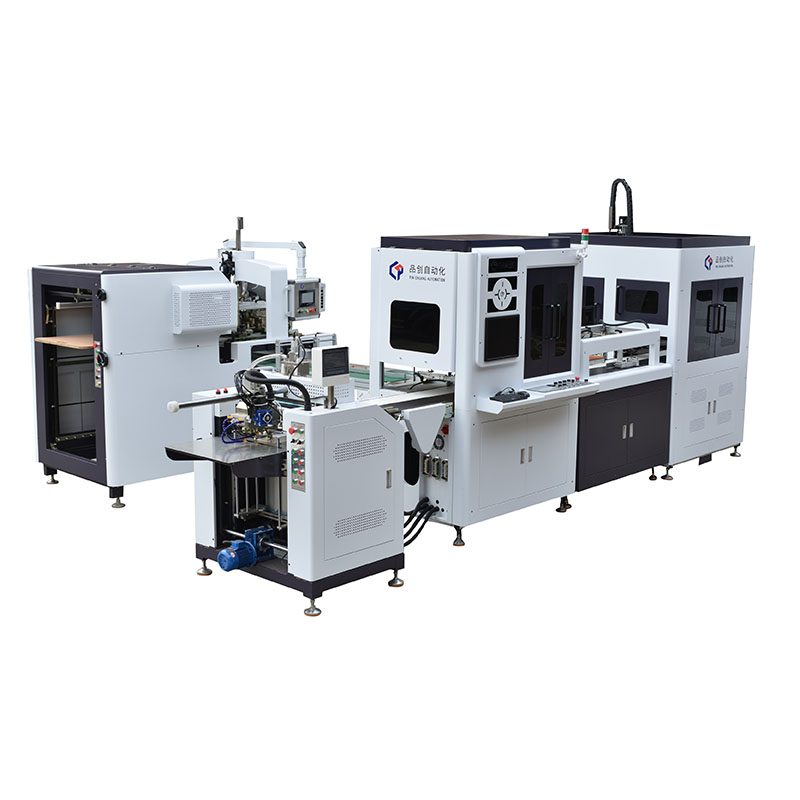
A rigid box making machine for jewelry boxes works at the opposite end of the size range from gift packaging, and that is where the difficulty sits. A 60 mm ring box leaves very little material for the wrap to absorb a fold, so the same mechanical tolerance that is invisible on a 300 mm base becomes a visible gap, a pulled corner or a lid that does not sit flat.
Pinchuang builds compact rigid box platforms for exactly this segment: small formats, thin board, short mixed batches and a wrap that has to stay clean. The notes below cover why small formats are harder, the three accuracy points that decide acceptance, how to run short batches without losing the setting, and what to check on the finished box.
Why a Rigid Box Making Machine for Jewelry Boxes Is Harder Than Large Formats
The reason is proportion, not absolute precision. A wrap paper of 150 g/m² has a thickness that has to be absorbed at every fold; on a large box that thickness is a small fraction of the side wall, on a ring box it is a noticeable part of the corner radius. Every allowance in the process — turn-in depth, notch size, glue film, mould clearance — is the same physical value but a larger share of the finished box.
Small boxes also spend more time per unit in handling. At 45 × 45 × 15 mm, the minimum format of the compact platforms, boxes are picked, stacked and packed in greater numbers for the same production weight, so a line that is fast in cycles per minute can still be slow in boxes per shift if the exit end is not organised.
| Small format issue | What it looks like on the box | Usual cause |
|---|---|---|
| Wrap thickness at the fold | Corner looks bulky or the lid edge sits proud | Turn-in depth and notch not matched to the paper |
| Thin board walls | Sides bow inward between the corners | Mould support too loose for 1–3 mm greyboard |
| Small glue volume | Blistering or a dry edge on one side only | Glue film set for a larger format |
| Handling at the exit | Scuffed surfaces, boxes nested too early | Stacking before the glue has set |
This is why compact platforms are specified rather than a large machine run slowly. The PC-350A and PC-350B are built around a 45 × 45 × 15 mm minimum and a 300 × 260 × 100 mm maximum, with 1–3 mm cardboard and 80–200 g/m² paper. The mechanism is sized for that envelope instead of being a full-size line with the settings turned down.
Accuracy Points: Tolerance, Wrap Wrinkles and Corner Tightness
Accuracy in jewelry packaging is judged at three points, and all three are physical rather than digital. A machine quoted at ±0.1 mm positioning accuracy is holding the position of the box or the paper; whether that becomes a good box depends on the mould, the wrap and the glue.
Tolerance between lid and base
A jewelry box is usually opened and closed in front of a customer, so the fit is part of the product. The gap has to be designed, and it has to repeat. When the lid is formed with a slightly different wrap allowance than the base, the box closes with a light drag on one side and a gap on the other, which no amount of inspection at the end can correct.
The practical fix is to build the lid and the base from the same mould set where the design allows it, and to record the settings for each size so the next batch starts from the values that worked rather than from a guess.
Wrap wrinkles at the corners
Wrinkles on a small box almost always come from too much paper at the corner. The ear folding size on these platforms runs from 10 to 100 mm and the paper folding depth from 10 to 80 mm, so the setting has a wide range; the correct value for a 60 mm box is not the value used for a 250 mm box. Reducing the ear and increasing the notch is usually more effective than increasing pressure, which only pushes the excess into a harder fold.
Corner tightness on thin board
Thin greyboard gives the corner less material to grip. If the mould does not support the wall during wrapping, the corner pulls away as the paper dries, and the gap appears a few hours after the box looked acceptable on the line. Leaving the boxes flat and unstacked through the first hours of drying solves more corner problems than any adjustment on the machine.
Running Short, Mixed Batches Without Losing Accuracy
Jewelry packaging is the segment where batch sizes are smallest and colour ranges are widest. A plant may run six sizes and twelve wraps in a week, which means changeover discipline matters more than rated speed. The machine that wins here is the one whose settings can be repeated, not the one with the highest number on the sheet.
A compact platform with corner pasting, forming and positioning built into one sequence removes the handover between stations, and every handover is a place where small boxes are dropped, mixed or re-oriented by hand. The PC-350B goes further with two box forming stations and a glue viscosity controller that adjusts the glue dosage automatically, which reduces the resetting work when the wrap changes.
Changeover time is mostly administrative. Moulds stored at the line and labelled by size, a sheet that records the ear, notch, depth and glue settings for each box, and the same operator doing every change will cut the lost time far more than a faster machine will recover it. Where a plant runs the same six sizes every month, the second batch is always faster than the first if the settings were written down.
- Keep one mould set per size, tagged with the box dimensions rather than the customer name.
- Record the wrap paper grade next to the settings, because the same box in a heavier paper needs a different ear and notch.
- Run a short trial of ten boxes after every change and check the lid fit before the batch continues.
- Keep the first and last box of each batch as a reference until the order ships.
Quality Checks for Jewelry Boxes
The inspection has to be done with the box in hand, at the line, on a sample taken from the batch rather than from the top of the stack. Four checks cover most of what a buyer will notice.
- Open and close the box against the base at three positions around the rim. The resistance should be even, with no point that catches.
- Turn the box over and look along the four bottom edges. A lifting corner shows as a fine shadow line before it shows as a gap.
- Check the wrap inside the lid, where wrinkles are least visible from outside and most visible to the customer.
- Measure the internal opening in both directions and compare it with the insert drawing, not with the previous batch.
Two compact configurations cover the jewelry segment, and the difference between them is throughput and the number of forming stations rather than the box range.


Pinchuang has manufactured rigid box and case making equipment in Dongguan since 2008, in a facility of around 10,000 m² with more than 100 employees, and supplies machines to over 30 countries. We exhibit at All in Print China, Printing South China, China Print, Drupa, SINO FOLDING CARTON and WEPACK. The compact platforms sit alongside the larger models on the rigid box making machine page, and the corner and forming stages that feed them are described on the corner pasting and forming machine pages.
Common Questions About Jewelry Box Production
How small a jewelry box can these machines make?
The compact platforms reach 45 × 45 × 15 mm, which covers ring boxes, earring boxes and small pendant cases. Below that, the wrap allowance becomes a large part of the wall and the box is usually assembled by hand rather than formed on a line.
Is a compact machine slower than a full-size line?
On paper, yes. The compact platforms run at 20–35 and 35–50 pcs/min, while larger platforms reach higher rates on large formats. On small jewelry boxes the compact machine usually wins on boxes per shift, because the larger machine cannot hold its accuracy at the bottom of its range without extra setup.
Can one machine run several jewelry box sizes in a week?
Yes, and that is the normal pattern in this segment. What makes it work is a mould set per size, written settings per wrap grade, and a short trial run after each change. Without those three, a mixed week turns into a week of adjusting.
What causes wrinkles on small wrapped corners?
Excess paper at the corner, usually from settings copied from a larger box. Reduce the ear folding size, increase the notch, and check the result on ten boxes before running the batch. Pressure alone tends to make the fold harder rather than flatter.
Send Pinchuang your jewelry box sizes, the board grade and the wrap papers you use, and we will confirm whether the range fits a compact platform. If the smallest box is under 45 mm, say so at the start, because that decides whether a rigid box making machine for jewelry boxes is the right answer for your range.
Send your jewelry box sizes See every compact model