

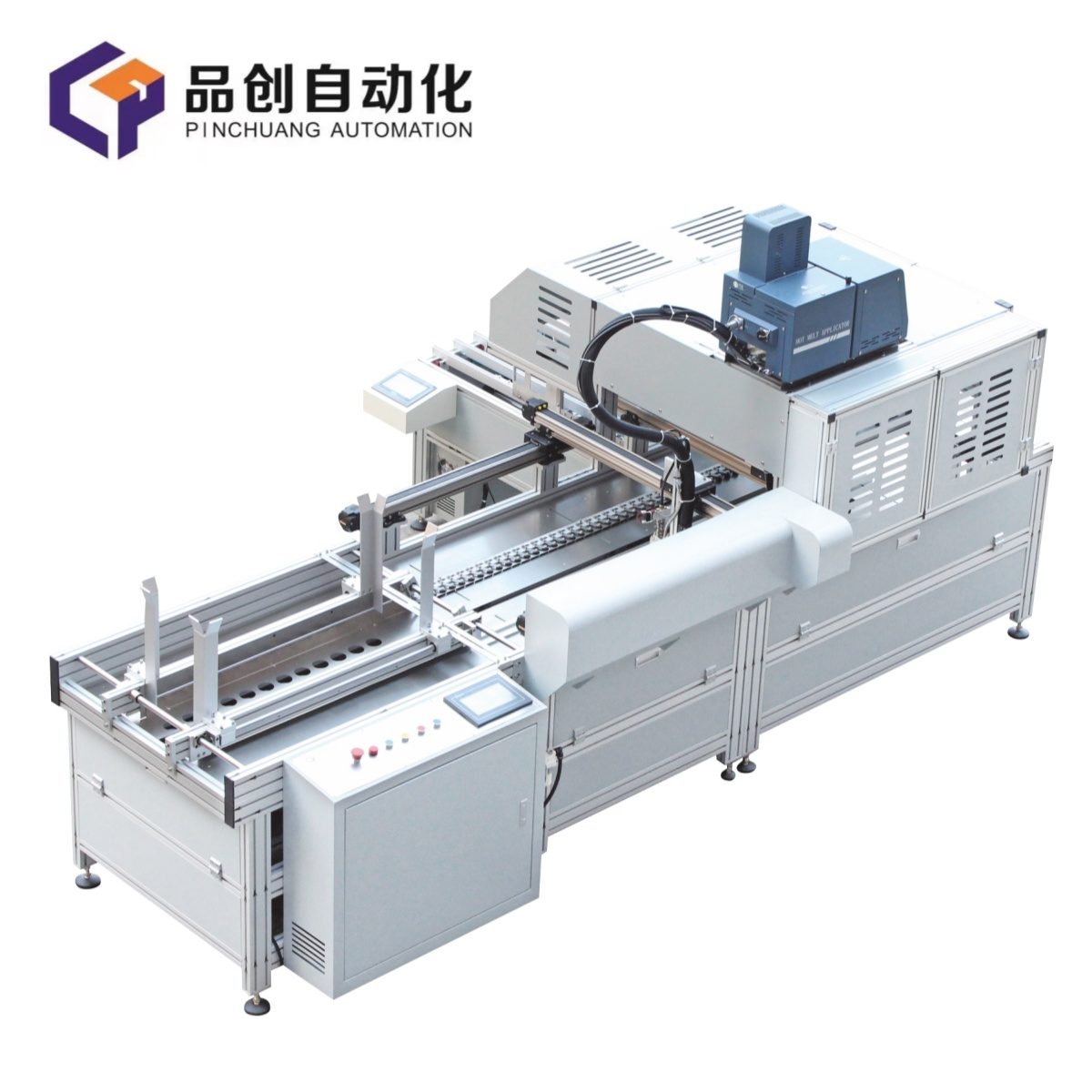
A rigid box making machine for cosmetic boxes has to hold two standards at once: a wrapped surface that survives retail handling without a mark, and a box that repeats exactly across a batch of tens of thousands. Beauty packaging is judged on the shelf and in the hand, so a scuff on a soft-touch lid or a lid that closes differently from the one beside it is a reject, not a minor variation.
Pinchuang supplies rigid box, case making and assembly equipment to cosmetic packaging plants and converters. The sections below cover what the machine has to meet, how laminated and specialty finishes behave at the forming station, how consistency is held across a long batch, and where assembly and visual positioning join the line.
What a Rigid Box Making Machine for Cosmetic Boxes Must Meet in Beauty Packaging
Three requirements come before output: an unmarked outer surface, a repeatable lid and base fit, and squareness that holds the insert and the printed panel in alignment. Cosmetic boxes are usually smaller and more decorated than gift boxes, and the decoration is the part that fails first.
The platforms used for this work cover boxes from 65 × 65 × 15 mm up to 500 × 400 × 120 mm, with 1–3 mm greyboard and 80–200 g/m² wrap paper. That range covers compact eye shadow cases as well as larger skincare sets, which is why many cosmetic plants run one platform across several product lines rather than dedicating a machine to one box.
| Beauty packaging requirement | Typical failure on a rigid box line | Control point |
|---|---|---|
| Clean decorated surface | Roller marks, glue bloom, fingerprints on matte film | Pressure settings, glue volume, exit handling |
| Repeatable lid fit | Magnetic closure that pulls to one side, uneven gap | Forming mould and positioning accuracy |
| Panel alignment | Printed pattern sits off-centre after wrapping | Vision-guided placement or trim allowance |
| Insert and tray fit | Tray rocks, or cannot be seated without force | Internal dimension held by the mould |
Surface Finishes: Laminating, Soft-Touch and Foil-Wrapped Board
The finish decides more of the setup than the box size does. A matte laminated sheet, a soft-touch film, a foil-stamped panel and an uncoated textured paper all behave differently when folded, and each one has a different tolerance for pressure, heat and glue.
Laminated stock is the most forgiving on strength and the least forgiving on marks. The film stiffens the sheet, which helps the fold stay sharp, but it also holds a roller impression and shows a glue smear as a dull patch. On a matte film the mark scatters light differently from the surrounding surface, so it is visible from an angle even when it cannot be seen from the front.
Soft-touch film is the hardest to run cleanly. The surface is designed to feel like velvet, which means it has a high coefficient of friction and picks up dust, glove residue and adhesive transfer. Everything that touches the wrapped surface after forming — guide rails, stacking trays, hands — has to be clean, and the boxes should not be stacked until the glue has set.
Foil-stamped board brings a different problem: the foil layer cracks at a sharp fold. A stamped panel that runs across a corner will show a hairline split if the fold radius is too tight or the board is too thick for the design. Where the artwork places foil near an edge, the design and the forming setup have to be agreed together, because the machine can only fold what the board allows.
Uncoated and textured papers absorb glue and water differently from film-laminated stock. On a porous sheet the adhesive can strike through and darken the surface, and the wrap can cockle at the turn-in as it dries. The usual answer is less glue, applied more evenly, and a check on a cured sample rather than a wet one.
Consistency Across a Large Batch
A cosmetic order is often tens of thousands of boxes in one size, produced over several weeks and sometimes on more than one machine. Consistency then depends less on the machine and more on what is written down and what is checked.
The first control is the paper batch. A wrap paper from a different lot can differ in caliper and in how it folds, and the difference shows as a corner that sits slightly fuller than the previous batch. Recording the lot number against the production run makes it possible to trace a change in appearance back to its cause instead of adjusting the machine at random.
The second control is the reference box. Keeping a sealed sample from the first approved batch, and comparing new production against it rather than against the previous shift, catches drift early. Drift is usually slow: a mould wears, a pressure setting creeps, a glue viscosity changes with temperature, and each small change is invisible until the boxes are side by side.
The third control is the glue. Cosmetic boxes are often assembled with magnet, tray and inner lining added after forming, and every added component is a place where a small amount of adhesive can reach the visible surface. A glue system that meters consistently, and a cleaning routine at the end of each shift, prevent most of the marks that appear on the outside of the box.
Where Assembly and Visual Positioning Join the Line
Not every cosmetic box leaves the forming machine finished. Book-style boxes with a magnetic flap, eye shadow cases with a hinged lid and skincare sets with a tray inside need an assembly step, and that step decides the final tolerance the customer feels.
An assembly machine takes the formed cover and the inner box and joins them with flat glue, automatic cover feeding, positioning and folding. The PC-900B is built for book-style boxes and handles covers up to L 900 × W 450 mm and inner boxes from L 90 × W 60 × H 5 mm up to L 450 × W 450 × H 120 mm, at 20–30 pcs/min and ±0.05 mm positioning accuracy. It can run white glue or hot melt, which matters when the cover material is coated and a water-based adhesive would not key.
The PC-900D is the eye shadow variant: same 20–30 pcs/min and ±0.05 mm, covers up to L 900 × W 450 mm, and inner boxes from L 90 × W 60 × H 2 mm to L 450 × W 450 × H 20 mm. The difference is the flat, shallow inner box it is designed to pick, position and fold around, which is the geometry of a palette rather than a book-style box.
Visual positioning joins the line before forming, where the printed sheet has to land in a fixed position relative to the board. On a cosmetic box with a centred logo or a pattern that must run continuously across the lid, mechanical registration against the sheet edge is not enough, because the print position varies within the sheet. A vision-guided station measures the actual print and places the board accordingly.
The three cards below show the forming platforms most often paired with cosmetic work and the assembly machine used for the eye shadow format.


Pinchuang has manufactured rigid box and case making equipment in Dongguan since 2008, in a facility of around 10,000 m² with more than 100 employees, and supplies machines to over 30 countries. We exhibit at All in Print China, Printing South China, China Print, Drupa, SINO FOLDING CARTON and WEPACK. The forming platforms sit on the rigid box making machine page, the upstream gluing stage on the gluing machine page, and the assembly step on the box assembly page.
Common Questions About Cosmetic Box Production
Can one machine run laminated and soft-touch wraps?
Yes, but not with the same settings. Laminated stock needs more pressure to hold a sharp fold; soft-touch stock needs the minimum pressure that closes the fold, plus clean rollers and careful handling after forming. Record both settings separately against the material name.
How is a magnet closure handled on a rigid box line?
The magnet is normally set into the board during the gluing and forming sequence, before the wrap closes over it. The part that decides quality is the position of the magnet pair, not the magnet itself: a millimetre of offset shows as a flap that pulls to one side when the box is closed.
When is visual positioning necessary for cosmetic boxes?
When the print position matters more than the sheet edge. Centred logos, repeating patterns that must wrap continuously, and brand elements close to the fold are the usual cases. Where the design has a generous trim allowance, mechanical registration is enough.
How do I keep consistency across a long cosmetic run?
Record the paper lot, keep a sealed reference box from the approved first batch, and compare new production against it rather than against yesterday's output. Check glue viscosity and roller condition at the start of each shift, because both drift quietly and both show on the finished surface.
Send Pinchuang the box format, the wrap finish and the assembly step you need, and we will confirm the forming platform and whether an assembly machine belongs in the line. If the box carries a magnet or a printed panel that must align, mention it now, because a rigid box making machine for cosmetic boxes is specified around the finish, not only the size.
Send your cosmetic box format See cosmetic packaging applications