

Rigid Box Making Machine for Luxury Packaging: Where Precision Becomes Brand Value
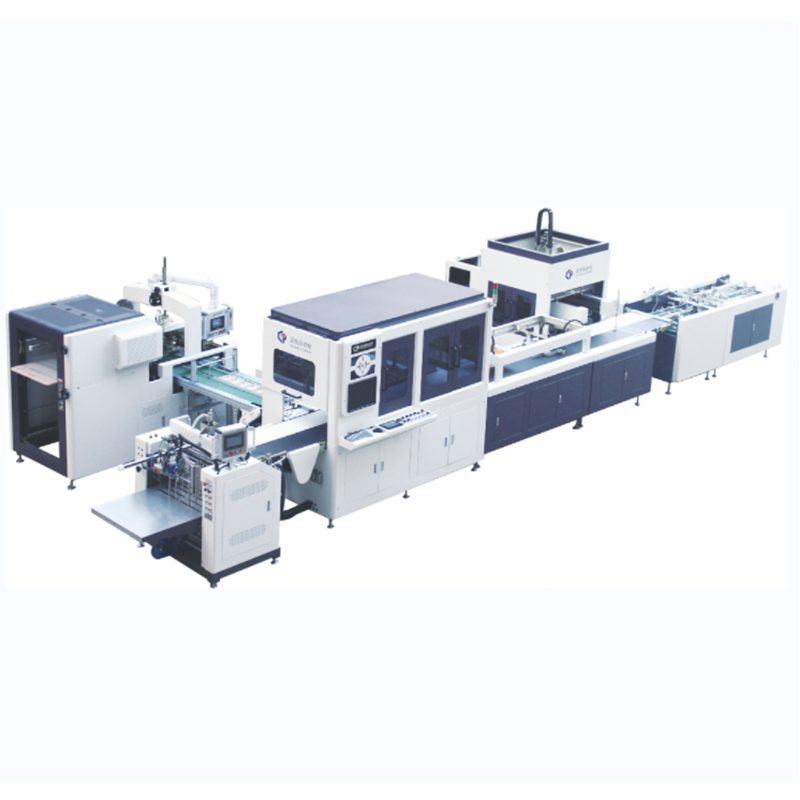
A rigid box making machine for luxury packaging is judged by what the customer feels in the first minute: the resistance of the lid, the evenness of the gap, and whether the box sits flat when placed on a counter. None of these appears on a specification sheet, and all of them are decided by tolerance, material pairing and the quality gate before packing.
Pinchuang builds rigid box and case making equipment for packaging plants serving premium and luxury segments. This article covers where precision becomes visible on the finished box, the three tolerances a customer actually perceives, how board and cover materials pair, and what the inspection gate should check before the boxes are packed.
Where Precision Becomes Visible on a Rigid Box Making Machine for Luxury Packaging
Precision becomes visible at the joints. A luxury box presents straight edges, tight corners and a flush lid, and any deviation is read as a defect because there is nothing else on the surface to distract from it. A printed pattern can hide a small error; a plain black matte lid cannot.
This is why luxury packaging projects usually start with the box construction rather than the machine model. Whether the lid sits over the base or inside it, whether the wrap turns around a separate frame, and whether the cover is one piece or a book-style assembly all change the mould set and the station arrangement. The machine follows the construction, not the other way round.
The platforms used for this segment span a wide envelope: boxes from 65 × 65 × 15 mm to 500 × 400 × 120 mm, covers up to 1000 × 500 mm on the combined box and cover machines, 1–3 mm greyboard and 80–200 g/m² wrap paper. Within that envelope, the differences between a good box and a premium one are almost entirely in the setup and the mould.
Lid Fit, Gaps and Squareness: The Tolerances Customers Feel
Three tolerances carry most of the perceived quality, and all three are felt by hand before they are measured with a gauge.
The gap around the lid
A luxury lid is expected to close with a slow, even resistance and to sit flush on all four sides. The gap is a design value, usually a fraction of a millimetre on each side, and it has to be the same on the fourth side as on the first. When the box is out of square, the gap opens on two opposite sides and closes on the others, and the lid appears to shift as it is pushed down.
Squareness starts at the corner pasting and forming stages, not at the lid. If the base is a fraction out of square, no amount of fitting will make the lid sit evenly, which is why the diagonal measurement of the opening is a more useful check than the outer dimensions.
Flush surfaces and step height
Where the lid meets the base, the two wrapped surfaces should form a continuous plane. A step of a few tenths of a millimetre is visible under raking light along the joint, and it is usually caused by a wrap allowance that differs between the two parts rather than by the board thickness. Setting the lid and the base from the same paper batch and the same turn-in depth removes most of it.
Corner geometry
A luxury corner is expected to be tight, with a clean line where the two wrapped faces meet, and with no bulge of paper on the inside. The corner is where the wrap has the least room and the most material, so the ear folding size, the notch and the pressure at the folding station all have to agree. A corner that looks acceptable in a photograph often fails when the box is held at eye level.
On the platforms used for this work, box production runs at 16–22 pcs/min on the combined box and cover machine and 26–40 pcs/min on the dedicated box machine, both at ±0.1 mm positioning precision. The slower figure is not a limitation for luxury work: at these volumes the line is usually limited by inspection and packing rather than by the forming cycle.
Material Pairings: Greyboard, Wrap Paper and Specialty Covers
Luxury boxes are usually built from the same basic materials as commercial ones — greyboard, wrap paper, sometimes a specialty cover — but the pairing is chosen for feel rather than for cost. The pairing decides how the box behaves on the machine as much as how it looks on the shelf.
| Material | What it gives the box | What it demands from the line |
|---|---|---|
| 1–3 mm greyboard | Rigidity and a solid feel in the hand | Mould support matched to board thickness |
| Coated art paper | Sharp print and a smooth, consistent surface | Pressure tuned to avoid polishing the coating |
| Textured and uncoated stock | Tactile finish associated with premium packaging | Glue volume control to avoid strike-through |
| Specialty covers | Leather-look, fabric or laminated finishes | Handling discipline and clean tooling at every station |
The pairing that causes the most trouble is thin board with a heavy cover. The cover has enough body to resist the fold, and the board has too little to hold it, so the wall bows and the corner opens. Where the design calls for a heavy material, the board usually has to move up within the 1–3 mm range, and the mould has to be adjusted to suit.
Wrap paper weight works the other way. A heavier paper covers imperfections in the board and gives a fuller corner, but it needs a larger turn-in allowance and more pressure at the fold. A 200 g/m² sheet on a small box can look generous or clumsy depending on how much material is left at the corner, and that is a mould decision rather than a machine decision.
Where the box and the cover are produced on the same machine, the cover work is usually faster than the box work: the PC-5010D runs covers at 20–30 pcs/min against 16–22 pcs/min for boxes, with covers from L 130 × W 90 mm to L 1000 × W 500 mm and up to six separate cover boards including the middle strip. That difference matters when planning a book-style luxury box, because the two halves of the product are produced at different rates.
The QC Gate Before Packing
In luxury packaging, the inspection gate is part of the process rather than the end of it. It should sit before the boxes are nested, wrapped or packed, because most of the defects that matter are easier to see on a single box than on a pallet.
The gate should check five things, in this order: the lid fit by hand, the diagonal of the opening, the corner tightness, the surface under raking light, and the inside of the lid where the wrap is least visible from outside. A box that fails any of the first four should not reach packing, because the fifth check cannot correct it.
- Use a fixed light at a low angle, the same one every shift, so a mark is judged against a constant reference.
- Keep the approved reference box sealed and compare against it, not against the last box inspected.
- Check the box both closed and open, because a lid that passes closed can still show a poor inner corner.
- Record the defect and the machine setting at the time, so a pattern can be found before the batch ends.
- Wear clean lint-free gloves at the gate, and change them at fixed intervals rather than when they look dirty.
Two platforms cover most luxury packaging work: a high-output box machine for single-construction runs, and a combined box and cover machine where the product includes a book-style cover or an irregular lid.


Pinchuang has manufactured rigid box and case making equipment in Dongguan since 2008, in a facility of around 10,000 m² with more than 100 employees, and supplies machines to over 30 countries. We exhibit at All in Print China, Printing South China, China Print, Drupa, SINO FOLDING CARTON and WEPACK. The box platforms are listed on the rigid box making machine page, the cover side on the case making page, and the corner stage on the corner pasting page.
Common Questions About Luxury Box Production
What tolerance should I specify for a luxury box?
Specify the fit rather than the machine number. State the gap you want around the lid, the maximum step allowed at the joint, and the diagonal tolerance of the opening. A machine at ±0.1 mm positioning can meet these, but only if the mould and the wrap allowance are built to the same numbers.
Can one machine produce both the box and the cover?
The PC-5010D does both: lid and base boxes at 16–22 pcs/min and hardcovers at 20–30 pcs/min, with up to six separate cover boards and a 10 mm middle strip. Where the product is a book-style box, producing both halves on one machine keeps the wrap allowance consistent between them.
Why does a luxury lid sometimes shift when closed?
Usually because the base is slightly out of square, so the gap is uneven on opposite sides. Check the diagonals of the opening before adjusting the lid. If the base is square, the cause is normally a wrap allowance difference between the two parts.
Is slower production normal for premium packaging?
At these volumes, yes. A luxury line is usually limited by inspection, handling and packing rather than by forming speed, and a slower cycle with a stable setting produces fewer rejects than a faster one that needs constant adjustment.
Send Pinchuang the box construction, the board and cover materials and the fit you expect, and we will confirm the platform and the mould set behind it. Precision on a rigid box making machine for luxury packaging is a specification agreed before the order, not a result adjusted after it.
Send your box construction Browse the box and cover range