

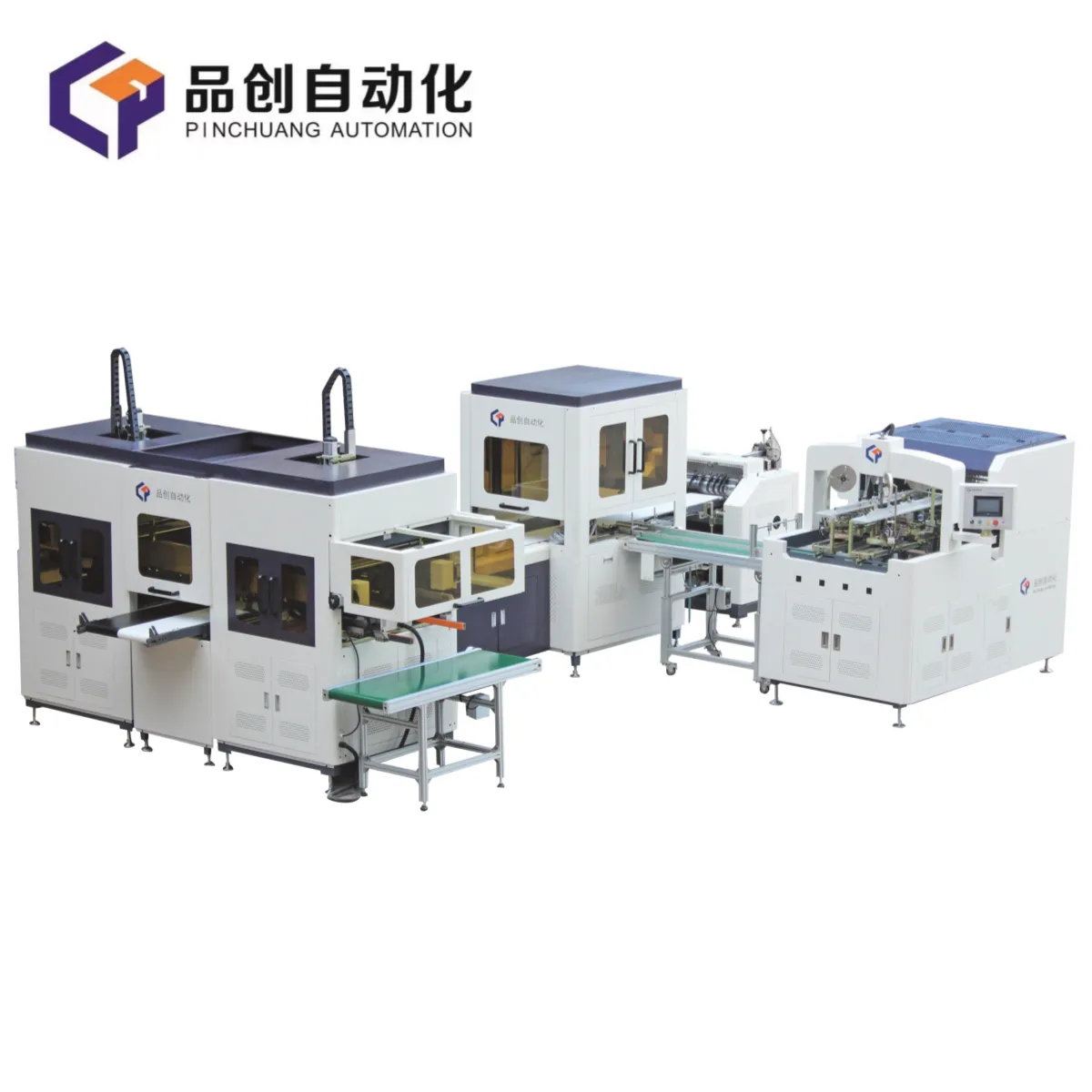
An automatic rigid box production line is planned from three numbers, not from a machine list: the box range you have to cover, the peak volume you have to absorb, and the number of size changes you run in a normal week. Station count, buffer size and headcount all follow from those three figures.
Pinchuang configures these lines for packaging plants and print finishers, and the projects that go wrong usually start with a machine preference rather than a production profile. This article follows the sequence we use in practice: settle the three numbers first, plan output for peak weeks instead of annual average, decide what stays manual, and plan changeover before anything is ordered.
Three Numbers to Settle Before You Plan an Automatic Rigid Box Production Line
The first number is your real box range, meaning the smallest box you run in a normal month and the largest you have run in the past year. The spread matters more than either end. A plant running 80 × 80 mm jewellery lids and 400 × 300 mm gift bases in the same week spends far more time on tooling than a plant running a single size, and the line has to be planned accordingly.
As a reference point, the PC-5040A and PC-5040B platforms cover boxes from 65 × 65 × 15 mm up to 500 × 400 × 120 mm, built for 1–3 mm greyboard and 80–200 g/m² wrap paper. If your range sits comfortably inside that envelope, the decision is about configuration and output. If your small formats sit below it or your board runs heavier, the forming station and mould set change the answer, and it is better to know that at the planning stage.
The second number is wall height. Boxes taller than about 80 mm behave differently at the forming station: the wrap has further to travel, the corners are harder to hold square, and cycle time lengthens even when the machine is rated for the size. Plants that quote the same rate for a 30 mm lid and a 110 mm rigid gift base usually find the second one runs slower in reality.
The third number is the one most often left out of the enquiry: how many size changes a week the line will actually be asked to make. It decides whether you are buying throughput or flexibility, and those two are not the same machine.
Output Planning: Average Demand vs Peak Demand
Size the line to your annual average and it will be short of capacity every time demand spikes. Size it to your absolute peak and it will stand half idle for the rest of the year. The practical compromise is to plan capacity around the peak season of your own order book, then decide how the plant will cover the difference — with a second shift, with subcontracted forming, or with a machine that has spare stations.
| Planning basis | What it means on the floor |
|---|---|
| Annual average | Lowest equipment spend, but the line runs overtime or outsources for eight to twelve weeks a year and delivery dates slip in exactly the season that matters |
| Absolute peak | Comfortable delivery in every month, but capital sits in a machine that is underfed for most of the year |
| Peak season plus a second shift | The usual answer for gift and cosmetic work: one machine sized for about 70–80% of peak, with a second shift carried in the plan |
Peak demand also changes the shape of the line, not just its size. In a busy week the constraint moves. Forming that keeps up in a normal month becomes the wall in November, because everything upstream is already running flat out and there is nowhere to store work in progress. Forming is therefore the station to measure first: its cycle rate sets the ceiling for the whole line, and every other station only has to keep up with it.
Manpower: What Stays Manual at Each Station
No automatic rigid box production line runs without people, and the headcount that matters is not the number of machines. Automation removes handling between stations; it does not remove material in, inspection, packing, or tooling change. Those four activities set the real staffing level, and each one scales differently with volume.
Material in
Board and wrap still arrive in stacks and reels and have to be loaded. A grooving station fed from a pallet needs someone within reach; a gluing station running light wrap needs reloading more often than the box making station needs attention. On a line running several sizes a day, loading is the role most often underestimated, because each size change means a fresh stack and a different pile height.
Inspection
Inspection stays manual on most lines, and it should be planned as a station rather than as something an operator does while watching the machine. One inspector checking a defined sample per shift, against a written standard for corner squareness, turn-in evenness and wrap adhesion, catches more than three people glancing at the output. The standard is what makes the role predictable; without it, inspection quality depends on who is on shift.
Packing and palletising
This is where a line that looks automatic in the brochure turns back into manual work. Rigid boxes are bulky and easily marked, so most plants pack by hand at the end of the line. Plan the packing bench at the exit, not across the aisle, and allow space for cartons and a pallet position; a line that ends in a narrow walkway loses more time in packing than it gains in forming.
Tooling change
Mould changes are skilled work and should be assigned to one or two trained people rather than to whoever is free. The same two people every time means the change is done in the same order, the settings return to the same values, and the first box after a change is right more often. This single decision affects changeover time more than any machine option.
Changeover Planning for Mixed Orders
A line rated at 40 pcs/min and changed over twice a day produces less in a week than a line rated at 25 pcs/min changed over twice a week. Buyers compare the first number and live with the second. Before choosing a configuration, time an actual size change on your current equipment, including the trial boxes, the adjustment run and the first-hour rejects.
Three things shorten changeover, and none of them is a machine specification. Standard mould storage at the line, with each set labelled by box size; a changeover sheet that records the settings that worked last time; and a fixed order of operations, so the same steps happen in the same sequence regardless of box size. Plants that do these three things usually change over in half the time of plants that do not, on identical machines.
The machine choice follows from the order profile. Where runs are long and repeatable, the faster platform pays for itself; where runs are short and mixed, a platform that combines corner pasting, forming and positioning in one pass removes a whole handover point and the queue that goes with it. Both configurations below cover the same box range and the same board thickness — the difference is station arrangement and output.


Pinchuang has manufactured rigid box and case making equipment in Dongguan since 2008, in a facility of around 10,000 m² with more than 100 employees, and supplies machines to over 30 countries. We exhibit at All in Print China, Printing South China, China Print, Drupa, SINO FOLDING CARTON and WEPACK, which is where most of these planning conversations begin. The configurations we build most often sit on the rigid box making machine platform, and the applications behind them on our applications page.
Common Questions About Line Planning
How many stations does an automatic rigid box production line need?
Four at minimum: grooving, gluing, box making with positioning, and forming. Corner pasting and assembly are added when volume or box type justifies them. Many plants start with the box making station alone and add the upstream stations as output grows, which is why we plan the layout for the end state even when the order covers one machine.
What output can I expect in a real shift?
Take the rated rate and discount it for the work you actually do. The 5040 platform runs at 16–25 pcs/min on the combined configuration and 26–40 pcs/min on the high-speed one, but a shift with three size changes will produce well below the rated figure. Plan on the number you can repeat every day, not the one on the specification sheet.
How much floor space should I reserve?
The PC-5040A platform occupies L 8200 × W 6000 × H 2150 mm and the PC-5040B L 8200 × W 4200 × H 2150 mm. Reserve additional space for mould storage, material in, packing at the exit and service access on at least two sides. Footprint drawings look generous until someone tries to change a mould with a wall behind the machine.
Can the line handle short runs and seasonal peaks?
Yes, if changeover is planned rather than improvised. What decides it is not the machine alone but whether moulds are stored at the line, whether settings are recorded, and whether the same people do every change. A line planned for the peak season and run in two shifts usually covers seasonal work better than a larger line run in one.
Send Pinchuang your box range, board and wrap specification and your busiest month, and we will come back with a station layout for an automatic rigid box production line that matches how your order book actually behaves.
Send your busiest month profile Compare the line machines